
I’m in Dallas where I saw The Police with my sister. (The tickets were her birthday present.) Afterward I was checking out their respective website and it looks like Andy Summers, the guitarist, has a WordPress blog. His site also has some interesting essays and photography.
EOS Digital Rebel XT
I used to think that paired opposites were a given, that love was the opposite of hate, right the opposite of wrong. But now I think we sometimes buy into these concepts because it is so much easier to embrace absolutes than to suffer reality. I don’t think anything is the opposite of love. Reality is unforgivingly complex.
— Anne Lamott
From her great book Bird by Bird.
Random Redirect Plugin
I just updated the Random Redirect plugin, with two extra parameters.
Upgrade Music
Bangkok Boat Tour
A boat tour of several temples in Bangkok, followed by a dinner with traditional Thai dancing.
WordCamp Events Friday
There are two events happening before WordCamp officially kicks off on Saturday. Tomorrow at 1 PM there is a meetup at Crossroads Cafe which should be a lot of fun. And then at 6:30 there’s a dinner meetup organized by Niall at a neat place called Taylor’s Automatic Refresher, which is an outdoor beer and burger place at the Ferry Building. (Same place we met last year.) It’s cafeteria style, and we’ll be outside chatting. San Francisco evenings tend to get chilly near the water so bring a jacket.
Chicken and Eggs
I’ve been reading Questlove’s Mo’ Meta Blues, and it’s an incredible education. The book is helping me appreciate an era of music that inspired the era that inspires me — the music that drove the Roots, J Dilla, Fugees, D’Angelo, Common, Erykah Badu, Kendrick Lamar, and so many more to create what they have.
Chronologically, I’m in a chapter covering mid-90s hip-hop, which is full of conflict. There’s a tension alluded to in the book of the musicians that made it and those that didn’t: does increased radio play make songs popular? There’s some science that suggests yes. Or is there something intrinsic to the record that puts it in that virtous loop of requests and airplay, the equivalent of usage and virality in a web product?

There’s a great ancedote in the book that I think is useful when thinking about products. All of the links are my addition, not in the original text.
There was one moment during the recording of Voodoo that really brought this home. We were recording DJ Premier’s scratches for “Devil’s Pie,” and Q-Tip had just let the room to go work on something else, so there were four of us left there: Premier, Dilla, D’Angelo, and myself. During the break, Premier asked if anyone had any new shit to play for the group, and D’Angelo went for a cassette and played a bit of a new song, and the whole room just erupted in hooting. Then Dilla put on some new Slum Village shit and it was the same thing: an explosion of excitement. Then Premier, who had started the whole thing, played an M.O.P. song and some new Gang Starr material that he was working on for The Ownerz.
I was last at bat. All I had on me was a work tape for what would eventually become “Double Trouble” on Things Fall Apart. It didn’t have finished vocals yet, didn’t have Mos Def’s verse. It was just a skeleton. I played it, and I will never forget the feeling that came over the room, including me. It wasn’t that they didn’t hoot and holler like they had for the other songs. They did. But they didn’t mean it. I know the move people resort to when they’re not quite into a song: they keep a straight stare on their face and bob their head a bit, not saying anything, not making eye contact. That’s the sign of death. That’s what they all did to me, and I felt humiliated. I was like Glenn Close in Fatal Attraction: I will not be ignored! I went back into the studio that same night and gave that song a radical, extended facelift. I refused to sleep until I had that thing up and running.
I love the idea of Questlove realizing the song was missing something, and going back to the booth to keep working on it until it resonated with his target audience. A song that doesn’t stand up on its own wouldn’t be any better when bundled as part of an album. (Or Samsung would have the most popular apps on Android.) Fans hear the care and quality of each track, and they become super-fans. The bands that break out weren’t bludgeoned into fan’s ears by radio play, they were pulled by these passionate few into a wider audience.
I love the mixtape culture that so many of today’s successful artists have come up through, and it is amplified online. Drake had three ever-improving mixtapes before his first album. It harkens to a line from PG’s startup canon (in 2009!): Better to make a few users love you than a lot ambivalent.
There’s this tension in everything we produce. Where’s the line to tread between 1.0 is the loneliest and a minimum viable product? Or is it about a minimum lovable product? Are we building a car with no air conditioning or a car with no wheels?

“Pivot” has become passé, but it’s much worse to assume that distribution will solve something core to your product that isn’t working.
LDAP Authentication
A hack for a LDAP enabled WordPress 1.5. More and more large organizations with external authentication are using WordPress internally.
Open Keys
I could write about many things, but instead I think I will relate the fact that for the second consecutive day, I locked my keys in the car. The details are inconsequential, and it’s a story everyone has heard before, so let’s start discussing solutions. In computing the key [pun] to failsafe systems is redundancy, so I have decided to take the same approach with the entry system to my car.
I’m going to allow anyone who thinks they would be willing to hold on to a key to my car to apply by email to receive a copy free in the mail. Only requirements are a name, phone number, and meeting my secret requirement which I will not disclose here.
Now I’m sure many of you are concerned with the security model of having numerous copies of my car keys floating around, but the manufacturer (Chevy) of my vehicle already thought of this, separating the entry and ignition functions into two separate keys. This has its advantages and disadvantages, as evidenced by the Saturday lockout when I had my ignition key but not the entry key. Access to my vehicle is something I’m willing to allow because trustees of the keys will be people I trust not to steal something from my car in the first place.
I have a number of people “pre-approved” for keys, including my parents, Grandmother, sister Charleen, Josh, Sarah, Sarah, Rachel, Rene, Rebbecca, Elissa, Iram, Mat, Chris, extended family, and selected staff at Kaveh Kanes, Tropioca, and Get Wired, but like I said before anyone is eligible. These people have been carefully selected for proximity and accessibility—at any given point in my life, I am never more than 5 minutes from at least one of these people. So there you have it! A trade-off of security versus accessibility in real life. We’ll see how this goes…
These limited edition PhotoMatt keys will be accompanied by a Certificate of Authenticity and will be available in several styles to complement any key ring. They will also be hand tested by yours truly to verify that they truly work. Get yours while they’re hot. (Limit one per person.)
TextDrive
Dean offers hosting, and pledges 10% of the fee to anyone who uses WordPress on it. Available for a limited time only. Those specs sound killer. You can’t deny that man’s flair.
Le Monde
The French newspaper Le Monde has moved all their blogs from Typepad to WordPress, if only I could read French.
On Cranky Geeks
I was on episode #76 of Cranky Geeks with John Dvorak, Sebastian Rupley, and Om Malik. We talked about Bubble 2.0, unions, iPhones, and vasectomies. This episode was a lot of fun and I suggest checking it out.
As part of the SOPA Strike, here’s the homepage of WordPress.com today. We got started a little bit early, but figured it wouldn’t hurt to go more than 24 hours.
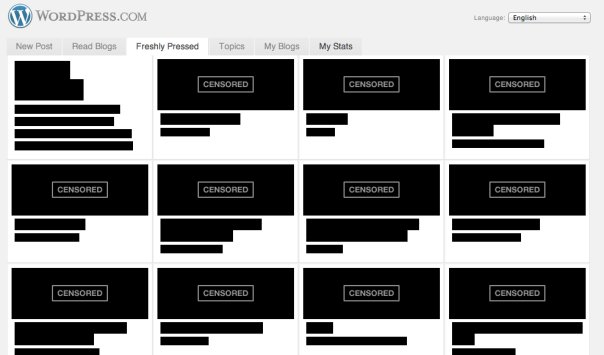
On WP.com we’ve activated an option for any of the bloggers there to put a ribbon on their site or black it out entirely, and we’ll be participating on WordPress.org as well.
Cookie Price Differences Explained
Well after much Googling, I found two definitive sources that say there are price differences in cookies. I found an article (word document, view as HTML) from the Wall Street Journal that talks about a price war in Michigan between neighbooring councils that had prices at $2.50 and $3.
Girls are told that if customers ask about the price difference, they should explain the economic factors at play — that the Metro council serves four times as many members as its “sister” council, and runs three more camps. Michigan Metro says its troops receive a profit of at least 45 cents on each box sold; in Macomb County, the minimum is 32 cents.
Oh that’s wonderful. Item 9 on this Girl Scout FAQ confirms that prices are set indivdually by over 300 councils.
Such scenarios have been repeated in other parts of the country, as many of the nation’s 330 Girl Scout councils go through their annual pricing debate. Officials say they can’t adopt the simple solution—setting one national price—because their parent organization, Girl Scouts USA, follows the Sherman Act, which prohibits price fixing.
With each council individually incorporated as a nonprofit organization, Girl Scout officials say the law, originally designed to rein in robber barons, could apply to them as well. “In being good citizens, we choose to abide by the spirit of the law,” says Girl Scouts USA spokeswoman Ellen Ach. At a national meeting of council leaders last month in San Diego, Girl Scouts USA officials reiterated their position that prices shouldn’t be discussed among local councils.
So there’s a legal reason for the price differences, but I think it’s highly unlikely that the Girl Scouts of America would be prosecuted under the Sherman Antitrust Act, though personally I think the prices are a bit high. It’s supply and demand, and I think people would buy more at a lower price. They are also outpacing inflation: my simple calculations using the GDP Implicit Price Deflator, which is Greenspan’s favorite measure of inflation, gives me that if a box of Girl Scout cookies was $2.50 in 1996 it should be about $2.80 now, give or take a few cents. There haven’t been any changes in quality I know of, they have a great distribution model, and I don’t see why their costs would have gone up at all to justify that sort of price increase. Just my two dollars and fifty cents…
MT Licensing
Six Apart announces more changes to Movable Type license. That sounds like a good model for WordPress.
MT Export Helper
Split Your MT Export File. I wrote a quick little web service to intelligently split large export files from Typepad and Movable Type into more manageable chunks.
Berlin Day 5
Final day in Berlin.
6 of the 10 Republican presidential candidates are using WordPress, the other 4 are on Drupal, which means all 10 are on an Open Source CMS.
Don’t Mess With Jay
Jay Allen, From Troll to Doppelganger. For what it’s worth, I ran the IP on the forums and no posts have been made to the WP support forums from that IP.