
WordPressDash is a Tiger dashboard widget for posting to WordPress.
On Cranky Geeks
I was on episode #76 of Cranky Geeks with John Dvorak, Sebastian Rupley, and Om Malik. We talked about Bubble 2.0, unions, iPhones, and vasectomies. This episode was a lot of fun and I suggest checking it out.
As part of the SOPA Strike, here’s the homepage of WordPress.com today. We got started a little bit early, but figured it wouldn’t hurt to go more than 24 hours.
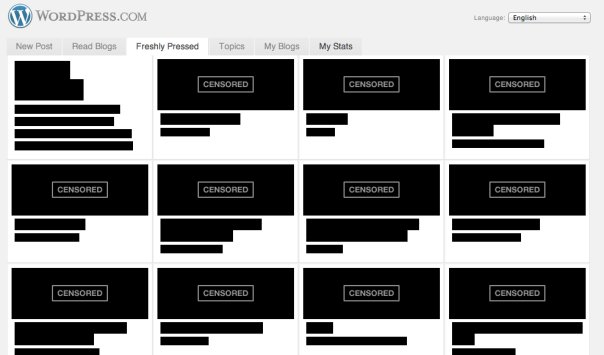
On WP.com we’ve activated an option for any of the bloggers there to put a ribbon on their site or black it out entirely, and we’ll be participating on WordPress.org as well.
Cookie Price Differences Explained
Well after much Googling, I found two definitive sources that say there are price differences in cookies. I found an article (word document, view as HTML) from the Wall Street Journal that talks about a price war in Michigan between neighbooring councils that had prices at $2.50 and $3.
Girls are told that if customers ask about the price difference, they should explain the economic factors at play — that the Metro council serves four times as many members as its “sister” council, and runs three more camps. Michigan Metro says its troops receive a profit of at least 45 cents on each box sold; in Macomb County, the minimum is 32 cents.
Oh that’s wonderful. Item 9 on this Girl Scout FAQ confirms that prices are set indivdually by over 300 councils.
Such scenarios have been repeated in other parts of the country, as many of the nation’s 330 Girl Scout councils go through their annual pricing debate. Officials say they can’t adopt the simple solution—setting one national price—because their parent organization, Girl Scouts USA, follows the Sherman Act, which prohibits price fixing.
With each council individually incorporated as a nonprofit organization, Girl Scout officials say the law, originally designed to rein in robber barons, could apply to them as well. “In being good citizens, we choose to abide by the spirit of the law,” says Girl Scouts USA spokeswoman Ellen Ach. At a national meeting of council leaders last month in San Diego, Girl Scouts USA officials reiterated their position that prices shouldn’t be discussed among local councils.
So there’s a legal reason for the price differences, but I think it’s highly unlikely that the Girl Scouts of America would be prosecuted under the Sherman Antitrust Act, though personally I think the prices are a bit high. It’s supply and demand, and I think people would buy more at a lower price. They are also outpacing inflation: my simple calculations using the GDP Implicit Price Deflator, which is Greenspan’s favorite measure of inflation, gives me that if a box of Girl Scout cookies was $2.50 in 1996 it should be about $2.80 now, give or take a few cents. There haven’t been any changes in quality I know of, they have a great distribution model, and I don’t see why their costs would have gone up at all to justify that sort of price increase. Just my two dollars and fifty cents…
MT Licensing
Six Apart announces more changes to Movable Type license. That sounds like a good model for WordPress.
MPAA Hardball
Ryan Duff got a letter from the MPAA for using Bittorrent. We need something more secure.
The Apple Blog
The Apple Blog looks good and runs WordPress. Hat tip: Om.
CEOs and the Real World
The downside of Zuckerberg’s exalted status within his company is that it is difficult for him to get genuine, unexpurgated feedback. He has tried, at times, to puncture his own bubble. In 2013, as a New Year’s resolution, he pledged to meet someone new, outside Facebook, every day. In 2017, he travelled to more than thirty states on a “listening tour” that he hoped would better acquaint him with the outside world. David Plouffe, President Obama’s former campaign manager, who is now the head of policy and advocacy at the Chan Zuckerberg Initiative, the family’s philanthropic investment company, attended some events on the tour. He told me, “When a politician goes to one of those, it’s an hour, and they’re talking for fifty of those minutes. He would talk for, like, five, and just ask questions.”
But the exercise came off as stilted and tone-deaf. Zuckerberg travelled with a professional photographer, who documented him feeding a calf in Wisconsin, ordering barbecue, and working on an assembly line at a Ford plant in Michigan. Online, people joked that the photos made him look like an extraterrestrial exploring the human race for the first time. A former Facebook executive who was involved in the tour told a friend, “No one wanted to tell Mark, and no one did tell Mark, that this really looks just dumb.”
There seem to be three communication gaps outlined here in Evan Osnos’s revealing profile of Mark Zuckerberg: one is getting unvarnished feedback from your employees. Speaking as a fellow CEO and founder, it’s certainly hard to pop that bubble — see “the bear is sticky with honey.” There are a few techniques like skip-level 1:1 meetings, anonymous feedback forms, interviewing new hires, and 360 reviews you can do to try to counter this, but there’s no panacea and this one requires constant work as you scale.
The second gap is getting the unvarnished truth from your users — much easier, as they’re quite happy to tell you what’s what. I’ve recently started cold-calling (yes, on the phone!) some of our Jetpack customers just to understand what they love and don’t love about the experience and about how we can help them solve their business challenges. There’s a casual intimacy to phone conversations that just can’t be replicated in other user feedback forums. Pair this with good instrumentation throughout your product so you see what people do and not just what they say and you’re golden.
The third and last communication gap is the connection to the world as most people experience it. If your status, wealth, or celebrity reach a point that they are shutting you out from “real” experiences, take some risks and get outside of your comfort zone. As it turns out, this new GQ profile of Paul McCartney offered a tip on that:
McCartney tells me a further such story of a time he took the Hampton Jitney, the slightly upmarket bus service that runs from the Hamptons into Manhattan, because he was deep into Charles Dickens’s Nicholas Nickleby and he wanted to finish it, and how he then took a local bus uptown, and when a woman blurted from across the bus, “Hey! Are you Paul McCartney?” he invited her to sit next to him and chatted all the way uptown. “It’s a way of not worrying about your fame,” he says. “It’s a way of not turning into the reclusive rock star. I often say to Nancy: I get in their faces before they get a chance to get in mine.”
Makes me wonder if Jack Dorsey still rides the bus to work every day. I think this is what Zuckerberg was attempting with his 30-state tour, and hopefully it was helpful even if the optics didn’t appeal to everyone — the daily habit of his 2013 resolution to meet someone new every day feels more powerful than the touristic 30-state one. But for an entity as large as Facebook maybe it’s moot, as Casey Newton pointed out in his newsletter last week it can be quite hard to pin the answers to Facebook’s real problems, and our democracy’s real challenges in the face of targeted online propaganda, to just one person.
MT Export Helper
Split Your MT Export File. I wrote a quick little web service to intelligently split large export files from Typepad and Movable Type into more manageable chunks.
Moleskine Blog
Jeremy Boggs wrote in to point me to this very neat blog where each entry is a scanned page from a Moleskine notebook.
Gravatar Blog
The Globally Recognized Avatar blog is using WordPress. The idea is pretty cool. Hat tip: Mathias.
Berlin Day 5
Final day in Berlin.
Netscape Crushes Competition
Anyone else notice similar trends on their site? Here’s my browser stats for this month to date:
- Netscape — 40.23% (Version 6 mostly.)
- Internet Explorer — 29.46% (70% version 6.)
- SharpReader — 4.99%
- Mozilla — 4.81% (Mostly 1.4, but with 1.5 not far behind.)
- Googlebot — 3.11%
WhatsApp Takeaway
 For better or worse, a great deal of investment in technology is driven by pattern matching. In that world any company (including Automattic) that generally eschews hype, is largely subscription driven, and has a small number of employees relative to its audience should be thrilled at the 19 billion dollar acquisition of WhatsApp. The deal is incredible.
This has kicked off another round of pattern matching and halo effects, which are currently incredibly favorable but will evolve over the coming years based on how things go post-integration, just like the public perceptions of Geocities, Youtube, Doubleclick, Bebo, and Skype wildly shifted based largely on the press coverage over their latest traded value.
I’m thrilled with the outcome for WhatsApp and the manner in which they built their company, their product, and I hope they bring more of that thinking to Facebook, but I don’t think they should become a playbook any more than Instagram should inspire a no-revenue playbook. The pattern we should take away from this story is that there is no pattern. (In Perl, “there’s more than one way to do it” or Tim Toady.) As an entrepreneur making decisions for your company, always go back to your first principles of what’s important to you and why you started in the first place. As a journalist, try not to fit everyone into arcs you’ve seen before or ascribe value to previous coverage (or lack of coverage). As an investor try to evaluate every situation on its unique merits. Should founders be CEOs or not? Well, it depends on the founders, the company, and what it means to be CEO, not what an over-normalized sample of a few hundred companies did before in completely different contexts.
There are also products that succeed with design that seems childish or terrible on the surface (Myspace, eBay, Snapchat). A lot of what it comes down to is have you made something people want, and are they finding out about it from their friends. That’s often the realm people think of as marketing. The best marketers in the world don’t fit our preconceptions of what that word means because they’re in hoodies instead of suits and create environments and ecosystems rather than the traditional trappings of marketing.
Update: From @dsa, here’s a great follow-up read on Techcrunch: What Games Are: Flappy Bird, Patterns, And Context.
6 of the 10 Republican presidential candidates are using WordPress, the other 4 are on Drupal, which means all 10 are on an Open Source CMS.
Don’t Mess With Jay
Jay Allen, From Troll to Doppelganger. For what it’s worth, I ran the IP on the forums and no posts have been made to the WP support forums from that IP.
Snow
It’s snowing! ’Tis the season. (My site, not San Francisco.)
Christian Lander on SWPL
Stuff White People Like’s Christian Lander: The Heeb Interview, a short interview with the fellow behind the now-famous SWPL (hosted on WordPress.com, naturally), which has already spawned copycats.
RSS Sky
Stanford Health
Stanford Community Health Resource Center looks like a highly modified WordPress installation. Hat tip: Gross Anatomy.