Category Archives: Facebook

Facebook, Meta, Instagram, and Zuckerberg.

Facebook / Instagram tip-off

In mid-January Mark Zuckerberg added me as a friend on Instagram (we’re also connected on Facebook), I grabbed this screenshot a few weeks later because I thought it might be interesting at some point:

Today the awesome news, for both Facebook and Instagram, comes that the Instagram team and product is being acquired. This is one of the first acquisitions (if not the first?) Facebook has made where they don’t plan to shut down the service, and it’s a testament to what Kevin Systrom, Mike Krieger, and his team have built. (Friendfeed is still running, but that doesn’t count.) It’s good to see old Pier 38 neighbors doing well.

I think there’s a difference between having a bestselling book–meaning through marketing, PR and buying that first wave of customers–and writing a bestselling book. The second implies that the product propels itself to the best seller list. That’s not to say that I’m Tolstoy or the best writer, but I used Facebook and Twitter more for feed back as I was creating and refining the book than for the actual marketing itself. My main online tool for priming the pump for the launch of the book was the blog. That was the heartbeat and the nexus for all the different tools that I use.

Via Tim Ferriss On Facebook, Twitter And Building A Huge Web Brand – Steven Bertoni – Money Talks – Forbes. I also liked this quote:

SB: How can a magazine catch up to the Web?

TF: If I worked for a magazine that’s very behind the times, I wouldn’t reinvent the wheel. I’d use WordPress as a content management system which has very good SEO out of the box. Companies spend so much time trying to develop something proprietary it’s ridiculous–you have thousands of people already working on WordPress.

Zuckerberg on Social

One thing that I think is really important — that I think is context for this, is that I generally think that most other companies now are undervaluing how important social integration is. So even the companies that are starting to come around to thinking, ‘oh maybe we should do some social stuff’, I still think a lot of them are only thinking about it on a surface layer, where it’s like “OK, I have my product, maybe I’ll add two or three social features and we’ll check that box”. That’s not what social is.

Social – you have to design it in from the ground up. These experiences, like what Zynga is doing or what a company like Quora is doing, I think that they have just a really good social integration. They’ve designed their whole product around the idea that your friends will be here with you. Everyone has a real identity for themselves. And those are fundamental building blocks.

From TechCrunch’s Interview With Mark Zuckerberg On The “Facebook Phone”.

Facebook Over-optimization

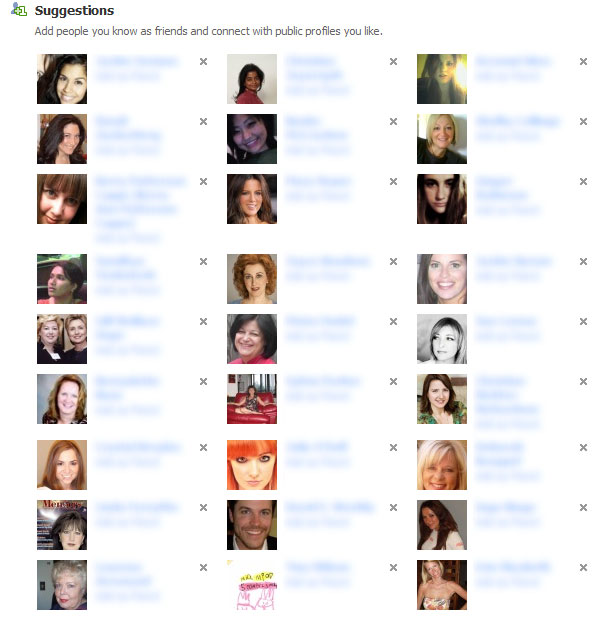
On Facebook I was trying to get to an event and clicked “see all” on the friend finder instead of the events area. Then something caught my eye, every friend Facebook was suggesting for me was female, and most I didn’t know. (Update, there’s one guy in there.) The first part of that is interesting — perhaps they’re testing some optimization in the friend-adder with the assumption that since I’m a straight male I’m more likely to add girls than guys, but if so that seems a little skeezy.

Facebook McAfee

Facebook is offering its users a 6-month free trial of McAfee and promoting it heavily, and even forcing people to run a scan before they can reactivate a hacked account. They’re “not aware of another free Internet service that takes this much responsibility for helping people keep their accounts secure.” (Didn’t Google promote McAfee through Google Pack at one point?) I think this is a laudable step, more security is intrinsically good, but I have to suspect this is more about revenue than security. They will probably make many millions of dollars from their users installing or buying McAfee as a result of this.

Modern versions of Windows include free tools like Defender which are just as good and appear to have less of a performance impact on the computer. But if they really wanted to have a long-term impact on desktop as a vector for attack on web services I’m surprised they didn’t start, sponsor, or promote an Open Source equivalent of McAfee. This seems like a space very well-suited to address with an OS tool in the digital commons, much like a Windows anti-spyware equivalent of SpamAssassin, with self-updating rules and a completely transparent process.

Facebook Fan

If you’re a Facebook user and a reader of this blog you can now add me to your Facebook. The “pages” feature of Facebook is neat because before I was conflicted because I wanted to add everyone I met at various conferences or WordPress users as a “friend” but then news feeds and such basically become unusable. I’m going to try to use it like a mailing list sending out some travel and life updates, like if I’m going to be in a particular country. Sign up here. 🙂

Marketplace Followup

Alex Jones has some good thoughts on the marketplace. As some stats, our themes page on .com got 2.4 million pageviews last month and someone previews a theme about once every 1.74 seconds. I can’t say how many people have purchased upgrades on .com, but even with our limited selection of products it’s a meaningful percentage, and that’s one of the reasons we think this idea has legs. It’s still impossible to know for certain, though, and I appreciate that our launch partners are taking a risk that they might create a theme and not sell a single one, and the whole thing might tank. If it goes well, though, I fully expect there to be thousands of themes in the system by this time next year, and the people in early will have a significant advantage, much like app developers did on Facebook.

Comscore Numbers

This snippet from the Wall Street Journal shows the Comscore numbers for the top social media sites, show us about 22 million ahead of Flickr and “Six Apart Sites” (which I think is Livejournal/Typepad/Vox combined) but about 9 million behind Facebook. I think the reason they say N/A for our growth is because a year ago we weren’t even tracked by Comscore. We’re too cheap for a subscription though, maybe someone with one can check that?

Mitch Kapor vs. Mark Zuckerberg

I’m here at Startup School and there is a really interesting contrast between the presentations of Mitch Kapor and Mark Zuckerberg. Lotus was one of the fastest growing companies of all time, and was widely heralded as one of the best working environments, and Mitch has been involved with some really interesting tech revolutions over the years. Mark Zuckerberg is of course the founder of Facebook.

Mitch’s presentation was one of my favorite of the day, and one of the thing he emphasized was that you should hire for diversity because diverse groups of people innovate more. Diversity here is defined as a function of experience, background, family status, as well as the traditional definitions like gender, et al. He says that one of the most common mistakes entrepreneurship makes is building “mirrortocracies” instead of meritocracies, meaning they tend to hire people like themselves rather than hiring the best people regardless of backgrounds, and the company suffers as a result.

Almost on cue, Mark started out by saying that the two most important things for a company is to have people who are “young and technical,” and his explanation of such was actually the entirety of his prepared remarks. (He arrived shortly before his presentation, so AFAIK hadn’t heard any of Mitch’s.) He made some fair arguments for biasing toward a technically inclined workforce, even in roles like marketing and support, however he didn’t really say anything compelling in support of youth, besides some vague references to many great creators and chessmasters being between 20 and 35 years old. But in no uncertain terms, he said they have a bias toward hiring young people at Facebook.

I’m inclined to agree more with Mitch. Biasing your decisions based on something completely out of someone’s control, specifically the year they were born, seems as likely to have correlation to talent and success in a company as gender, race, or anything else that everyone knows doesn’t matter. It’s not what you’re born with, it’s what you make of it. However in defense of Mark, you can think of Frank Sinatra’s Young at Heart. There’s youth, and there’s youthfulness. The latter could be described as a set of qualities, and could definitely something you look for when hiring, but make sure you’re targeting the right things.

What do you think: Is there something inherent in age that’s valuable? What’s the most important thing you look for when hiring?