Category Archives: WordPress.com

WordPress.com — the hosted platform, features, and updates.

Automattic 20 & Counter-claims

It’s a bit of Automattic lore, but although I founded the company in June 2005, CNET asked me to stay on for a few more months to finish out some projects, which I did. Our HR systems have me as the second employee, after Donncha O Caoimh (still at the company!) So today is my 20th anniversary at Automattic! It’s 20 years since I started hacking on Akismet, our first product, and on WordPress.com.

The team gave me a sweet surprise! I’ve been fighting for the open web for 20 years, and hope to do it for at least 20 more. There’s a lot of exciting behind-the-scenes stuff happening inside Automattic that also made this day special, but one significant thing is public.

Automattic has finally had its first chance to file its counterclaims that spell out the bad actions of WP Engine and Silver Lake, as reported here by TechCrunch. You may recall that last month, the court dismissed several of their most serious claims, and they responded by filing an amended complaint. In our dogged defense of the free, open, and thriving WordPress ecosystem, Automattic responded today with a comprehensive counter-filing, which you can read in a 162-page PDF here about all the things WP Engine/Heather Brunner and Silver Lake did wrong.

We’ve got receipts!

I don’t think WP Engine employees or investors were aware of the gaslighting they did, hopefully some of this is enlightening. And there’s a lot more discovery to go!

Probably the most interesting thing on the internet today is Andrej Karpathy’s nanochat, “a minimal, from scratch, full-stack training/inference pipeline of a simple ChatGPT clone in a single, dependency-minimal codebase.” 8,000 lines of beautiful code, as Simon Willison notes. If you want to understand how LLMs work, study this. Andrej is a code poet.

In hacking news, Wired has an amazing article on intercepting geostationary satellite signals.

On Friday, we turned on something cool: every WordPress.com site now supports MCP. Right now this is read-only access to your site, because the S in MCP stands for Security, but you can already start to do some cool stuff with it.

Linkrot

One of the things I hate most on the internet, and part of the reason I started WordPress, was to fight linkrot. Ever since 1998, when Tim Berners-Lee wrote “Cool URIs Don’t Change,” I’ve been obsessed with content management and ensuring that links don’t break. (BTW, TBL, a pioneer of creating the World Wide Web, has a great new profile out in the New Yorker.)

I learned today from the Newspack newsletter that the Houston Press is now on WordPress. Newspack is a distribution or bundle of WordPress designed for journalism, and it is led by Kinsey Wilson, who began his career as a night-shift journalist covering cops for a newspaper in Chicago, went on to have top editorial and business positions at The New York Times, NPR, and USA TODAY, and ran WordPress.com for a few years, which gives him a very unique position to help craft WordPress for journalists and publishers.

The Houston Press is an alt-weekly that wrote the very first profile of me in the world, which I blogged about here. There’s a funny quote in there:

He recently considered taking a job with a San Francisco search-engine start-up, but ended up turning them down. “They have a ton of money…But it would be 50- or 60- or 70-hour weeks, a lot of work, and I wouldn’t have time” to do WordPress. 

That “search-engine start-up” was Google! How the internet might have turned out differently if I had taken that job, as my Mom wanted me to (because they offered free food). I still think Google is one of the most interesting companies in the world, one of the few places I’d consider working if I weren’t running Automattic.

Back to linkrot, the original link to the profile in that article was http://www.houstonpress.com/issues/2004-10-28/feature2.html, which this morning didn’t work, but thanks to the Houston Press being on Newspack/WordPress I was able to ping Kinsey and his colleague Jason Lee was able to fix it so it redirects to the new canonical URL for that content in minutes. A little corner of the internet tidied up! I love the Wayback Machine, but not needing it is even better.

Every 6 Minutes

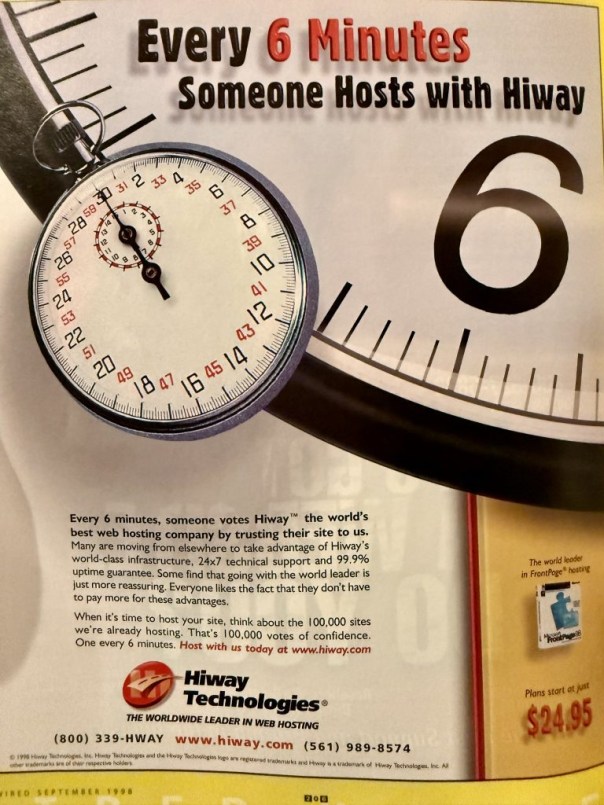
I’m at a dinner tonight and they have these old magazines on the table, including some old copies of WIRED, which, if you can imagine, as a kid in Houston in the 90s, was a portal to the amazing world of the internet and technology. I flipped through, and there is an entire web hosting classifieds section! Hiway Technologies wants you to know that every 6 minutes, someone hosts with Hiway.

Every six minutes, so they were doing 240 signups a day. 100,000 sites! Last month WordPress.com created a new site about every 3 seconds. Hiway was founded by Scott Adams, same name but not the Dilbert guy or the game designer, who apparently played football in Florida and the company “was sold in 1999 for $352 million. Adams was 35.

There was also this guy, who has a website, but do you?

WP.com Simplification

WordPress.com offers two modes of WP: WordPress and WordPress MS. For free and lower-priced accounts it runs a version of WordPress called WordPress MS, or WordPress Multisite, which is designed for super-efficient multi-tenant usage, which is what has allowed it to introduce hundreds of millions of people to WordPress and run at a huge scale. (It was initially called MU, for multi-user, but we had to change it because someone squatted the name WPMU and built a business on top that was confusing users with commercial products. Such is my curse.) It revolutionized the hosting industry in a number of ways, including acclimating customers to per-site pricing instead of unlimited domains and raising the bar for what a host would manage for users so they didn’t have to worry. It has also provided a highly secure base login, which allows us to offer popular SaaS services, such as statistics and anti-spam, to all WordPress users, regardless of where they’re hosted.

At higher-priced plans you’d get access to not just a curated set of plugins and themes but the ability to install anything you like from the ecosystem, which invisibly switches your account to WP.cloud in the backend that supports unlimited plugins and themes and custom code, in a way that’s still multi-datacenter and maintenance-free. This has been very successful and works great for a ton of customers, but it still puts an asterisk when you recommend WordPress.com to someone because they’d need to be on one of the higher-priced plans to get an experience of WordPress with custom plugins and themes.

For the first time ever we’re running a summer special where every single paid account gets that full WP.cloud experience with full customization and control. It’s a test we’re running until August 25th. It’s WordPress, without the asterisk, without limits, implemented in a way that’s intuitive and safe for novice users, while also being extremely powerful for developers. If you haven’t checked out WP.com in a while, it’s a great deal starting at just $4 per month. I’m curious to see the results of how this goes. We also have a number of more radical things I’m eager to try out! It’s a great time to reimagine what you’re doing from the ground up and question your longest-held beliefs, as AI has really put people in a more experimental and open mindset.

The long-anticipated “Big Sky” AI site builder on WordPress.com went live today. It combines several models and can create logos, site designs, typography, color schemes, and content. It’s an entirely new way to interact with and edit a brand-new or existing WordPress site. This AI agent will make WordPress accessible to an entirely new generation and class of customers, and it will be a power tool for professionals to do things in minutes that used to take them hours.

Automattic Operating System

I was interviewed by Inc magazine for almost two hours where we covered a lot of great topics for entrepreneurs but almost none of it made it into the weird hit piece they published, however since both the journalist and I had recording of the interview I’ve decided to adapt some parts of it into a series of blog posts, think of it as the Inc Article That Could Have Been. This bit talks about some of the meta-work that myself and the Bridge team at Automattic do.

At Automattic, the most important product I work on is the company itself. I’ve started referring to it as the “Automattic Operating System.” Not in the technical sense like Linux, but the meta layer the company runs on. The company isn’t WordPress.com or Beeper or Pocket Casts or any one thing. I’m responsible for the culture of the people who build those things, building the things that build those things. It’s our hiring, our HR processes, our expenses, the onboarding docs; it’s all of the details that make up the employee experience — all the stuff that shapes every employee’s day-to-day experience.

Take expense reports. If you’ve got to spend two hours taking pictures of receipts and something like that, that’s a waste of time. You’re not helping a customer there. We switched to a system where everyone just gets a credit card. It does all the reporting and accounting stuff automatically. You just swipe the card and it just automatically files an expense report. Sometimes there’s an exception and you have to work with the accounting rules, but it just works and automates the whole process most of the time.

Another commonly overlooked detail is the offer letter. We think so much about the design of our websites and our products. We have designers work on that and we put a lot of care and thought into it. But I realized we didn’t have the same attention to detail on our offer letter. When you think about it, getting an offer letter from a company and deciding to take it is a major life decision, something you only do a handful of times in your life.  This is one of the things that determines your life path. Our offer letter was just made by attorneys and HR. No designer had looked at it right. We hadn’t really thought about it from a product experience point of view. And so it was just this, generic document with bad typography and not great design. But it’s important, so one of the things we did was redesign it. Now it has a nice letterhead, great typography, and it’s designed for the end user.

I realized that the salary and stuff was buried in paragraph two. It was just a small thing in the document! Well, what’s key when you’re deciding whether to take a job? Start date, salary, you know, that sort of thing, so we put the important parts at the very top.

And then there’s the legal language. All the legal stuff, which is different in every country. We have people in 90 countries, so there’s all the legal stuff that goes in there. And then it has this nudge inspired by the behavioral economics book, Predictably Irrational.

There’s the story about how, if you have an ethics statement above where you sign the test or something, people cheat less. So I thought, well, what’s our equivalent of that? We have the Automattic Creed. It’s an important part of our culture. So we put the creed in, it says

I will never stop learning. I won’t just work on things that are assigned to me. I know there’s no such thing as a status quo. I will build our business sustainably through passionate and loyal customers. I will never pass up an opportunity to help out a colleague, and I’ll remember the days before I knew everything. I am more motivated by impact than money, and I know that Open Source is one of the most powerful ideas of our generation. I will communicate as much as possible, because it’s the oxygen of a distributed company. I am in a marathon, not a sprint, and no matter how far away the goal is, the only way to get there is by putting one foot in front of another every day. Given time, there is no problem that’s insurmountable.

It’s not legally binding, but it’s written in the first person, you read it and you kind of identify with it and then you sign below that. We want people who work at the company who identify with our core values and our core values really are in the creed.

These sorts of things are key to our culture. And they’re universal. Again, we have people from over 90 countries. These are very different cultures, yes, and very different historical backgrounds and cultural makeups. But what’s universal? We have our philosophies that we apply every day regardless of where you were born or where you work.

Real WordPress Security

One thing you’ll see on every host that offers WordPress is claims about how secure they are, however they don’t put their money where their mouth is. When you dig deeper, if your site actually gets hacked they’ll hit you with remediation fees that can go from hundreds to thousands of dollars.

They may try to sell you a security plan that for example at Godaddy goes from $300 to $700 a year on top of your hosting. (Don’t be fooled by the low entry price, look at renewal.) It’s heartbreaking to hear stories of non-technical people forced into these high fees to fix something their host should have prevented in the first place.

When a host is powered by WP.cloud, it doesn’t need to do this because hacks are so incredibly rare. (That’s why it may appear more expensive, but the total cost of ownership or being a WP.cloud-powered host is much lower when you factor in human time.)

One problem we’ve had on WordPress.com is we do all these amazing things and don’t tell anyone about it, something we’re trying to change with our focus this year on developers and developer tooling. One great example is we’re so confident about our security, if your site gets hacked we’ll fix it for free! We’ve actually been doing this for the better part of a decade, just never mentioned it anywhere.

Pressable (which is WP.cloud-powered) does a better job talking about these things and has a nice landing page on malware cleaning and hack recovery that says essentially the same thing.

WordPress has done a ton over the years to move the hosting industry around upgrading PHP and MySQL, PHP extensions, free SSL, and in general using our clout to advocate for user rights and freedoms from even the largest hosting companies, and I’m proud to say there are a good number, for example the ones you see at WordCamps, that have not just embraced these values but actually been more commercially successful as they’ve done so. I hope security and auto-upgrades not just for core but for plugins and themes becomes the next standard. (Jetpack does this for free, some hosts charge $100/yr per site.)

Studio Sync

WordPress.com launched a new update to Studio this week, and we’re already seeing some buzz.

Studio is our free and open source app for local WordPress development, enabling you to spin up unlimited WordPress sites on your personal computer.

Through its newest feature, Studio Sync, you have complete freedom to:

  • Connect your Studio site to and from a WordPress.com production or staging site, included for free in Business and Commerce hosting plans.
  • Push and pull changes as a team by connecting a local Studio site to a shared WordPress.com site.
  • Synchronize your local and hosted sites at any time with one click.

Studio is an excellent tool to have in your development arsenal, and you can download it for free, explore the docs, and become a contributor on GitHub.

Samattical

Today is the day! The first day of my sabbatical. What an experience it has been. On Thursday I delivered my very first Ignite talk on the subject! Here it is.

The Ignite format is a tricky one as a speaker! I will do better next time. My friend Connie has delivered seven Ignite talks now and I thought hers and Adam Savage’s were the highlights of the ones I saw. (I didn’t see everything because I was popping in and out.)

Preparing for this sabbatical has been the most fun I’ve had working at Automattic, ever. It brought so much clarity to things, we’ve been able to resolve in hours things that have lingered for months, including two acquisitions, several hires, big strategies, and more.

After this talk I caught a redeye to NYC to meet with the WordPress.com leadership team and hand off my leadership there to Daniel Bachhuber.

It is a beautiful symmetry that the first-ever sabbatical taken at Automattic was by its CEO at the time, Toni Schneider, which gave me the opportunity to step in and try on being a CEO, and it’s an incredible gift that Toni is returning to be CEO of Automattic while I’m out for the months of February, March, and April.

What am I going to do with all this free time? Blog a ton. So follow along if you want to see this journey. I’m going to try to open source all the things. 😇

Update: I ended up extending this to May 15 since it got a late start.

TED Future of Work video

My TED Video on the Future of Work

I was thrilled to participate in TED’s new video series, The Way We Work, and not surprisingly I made the case that distributed work is where everything is headed.

It has over 130,000 views already! What I really love about this video in particular is that we get into the specifics of how a company can start to embrace a culture of letting employees work from anywhere, even if it started out as a traditional office with everyone in the same place. Automattic never started that way, so even as we’ve scaled up to more than 840 people in 68 countries, there’s never been a question — it’s now built in to our entire culture.

For distributed work to scale up, it’s going to require more CEOs, workers, and managers to test the waters. Any company can experiment with distributed work — just pick a day or two of the week in which everyone works from home, I suggest Tuesdays and Thursdays, then build the tools and systems to support it. Yes, that may require some shuffling of meetings, or more written documentation versus verbal real-time discussion. But I think companies will be surprised how quickly it will “just work.”

If the companies don’t experiment, workers may force them to do it anyway:

Journalism and Newspack

WordPress.com is partnering with Google and news industry leaders on a new platform for small- and medium-sized publishers, called Newspack. The team has raised $2.4 million in first-year funding from the Google News Initiative, Lenfest Journalism Institute, Civil funder ConsenSys, and the Knight Foundation, among others. We’re also still happy to talk to and engage other funders who want to get involved — I’d love to put even more resources into this.

It’s been a difficult climate for the news business, particularly at the local level. It also breaks my heart how much of their limited resources these organizations still sink into closed-source or dead-end technology. Open source is clearly the future, and if we do this right Newspack can be the technology choice that lasts with them through the decades, and hopefully our 15 years of growth lends some credibility to our orientation to build things for the long term.

Here’s Kinsey in Nieman Lab:

The goal is to both make sure that the catalog of publishing tools as well as business tools they need to be able to run what one hopes is a sustainable news operation are addressed simultaneously. It’s not simply a CMS for a newsroom, but a full business system that enables publishing and monetization at the same time.

Nieman Lab interview

As you have come to expect from Automattic, everything will be open source and developed to the same standards WordPress itself is. We’re working with Spirited Media and the News Revenue Hub on the platform, and we will likely look for even more partnership opportunities from across the WordPress ecosystem. If you’d like to invest or get involved, drop us a line at newspack@automattic.com.

Scoop and Scale

NY Times did a neat article on their CMS Scoop, one cool piece of which is their ICE editor we worked on with them a few years ago. Their cropping stuff is also cool, though it’s dizzying how many sizes they need to produce. They included some numbers on the volume of content published through Scoop, “700 articles, 600 images, 14 slide shows and 50 videos per day,” and folks were asking about the latest from WordPress. Of course many people run WP on their own cloud or infrastructure, so these numbers aren’t comprehensive, but at least for WP.com and Jetpack blogs we now see every day 1,300,000 posts, 780,000 uploads (images and videos), and close to half of all posts have some sort of external content embedded in them, like a Youtube, Vimeo, or Tweet. I’m very proud that many members of the fourth estate from the Times to FiveThirtyEight are using WordPress.

New Funding for Automattic

I’ll start with the big stuff: Automattic is raising $160M, all primary, and it’s the first investment into the company since 2008. This is obviously a lot of money, especially considering everything we’ve done so far has been built on only about $12M of outside capital over the past 8 years. It was also only a year ago I said “Automattic is healthy, generating cash, and already growing as fast as it can so there’s no need for the company to raise money directly — we’re not capital constrained.”

I was wrong, but I didn’t realize it until I took on the CEO role in January. Things were and are going well, but there was an opportunity cost to how we were managing the company toward break-even, and we realized we could invest more into WordPress and our products to grow faster. Also our cash position wasn’t going to be terribly strong especially after a number of infrastructure and product investments this and last year. So part of my 100-day plan as CEO was to figure out what new funding could look like and we found a great set of partners who believe in our vision for how the web should be and how we can scale into the opportunity ahead of us, though it ended up taking 110 days until the first close. (Our other main areas of focus have been improving mobile, a new version of WP.com, and Jetpack.)

This Series C round was led by Deven Parekh of Insight Venture Partners, and included new investors Chris Sacca, Endurance, and a special vehicle True Ventures created to step up their investment, alongside our existing secondary investors from last year, Tiger and Iconiq. (There is a second close soon so this list might change a bit.) There was interest significantly above what we raised, but we focused in on finding the best partners and scaled it back to be the right amount of capital at the right valuation. Deven and Insight share our long term vision and are focused on building an enduring business, one that will thrive for decades to come.

WordPress is in a market as competitive as it has ever been, especially on the proprietary and closed side. I believe WordPress will win, first and foremost, because of its community — the hundreds of core developers and large commercial companies, the tens of thousands of plugin and theme developers, and the millions of people who build beautiful things with WordPress every day. Automattic is here to support that community and invest the full strength of our resources to making WordPress a better product every day, bringing us closer to our shared mission of democratizing publishing. But a majority of the web isn’t on an open platform yet, and we have a lot of work ahead of us. Back to it!

You can read more about the news by Kara and Liz on Recode: WordPress.com Parent Automattic Has Raised $160 Million, Now Valued at $1.16 Billion Post-Money, on Techmeme, and on the Wall Street Journal.

Why the Web Still Matters for Writing

I wanted to share unique perspective for why the web matters in an app world with a guest post from Stratechery writer Ben Thompson:

This week Twitter was abuzz with the most recent report from Flurry that showed people spending most of their time on mobile using apps, not the browser:

Time Spent in APps

Many were quick to once again declare “The Web is Dead,” but I’m not sure that conclusion makes sense, at least for writing.

First off, Flurry’s numbers don’t account for webviews within mobile apps. On my site, Stratechery, 37% of my iOS traffic comes from webviews (Android doesn’t break out the difference), which on Flurry’s chart would fall mostly in the Twitter slice. More mass market sites likely take up some percentage of Facebook time, as well.

That said, it’s striking how little written content appears on Flurry’s chart; the only category that is primarily about written content is news, and even that includes video. And yet, pageviews on WordPress.com and Jetpack are up 27% year-over-year, new sites ranging from small blogs like Stratechery to huge sites like FiveThirtyEight continue to launch and grow, and multiple startups (and competitors!) continue to find writing something worth investing in.

So is the web dead or not?

I don’t think so, for a few reasons:

  • The total amount of time spent on a computing device (especially mobile), has and continues to grow significantly. This means that many of the activities on our phones, app or not, are additive to what we previously used a computer for. This makes sense: what makes mobile such a big deal is that instead of a computer being a destination device, it’s now a companion that goes with us everywhere. This is how you square the fact that apps seem to dominate usage even as writing on the web continues to grow. When the entire pie is huge and getting bigger, the total size of any particular slice grows as well, even if it becomes relatively thinner.
  • Although apps take up a huge percentage of total time, a significant percentage of app time is dominated by just two categories: games (32%) and social networks and messaging (28%). In fact, the more interesting juxtaposition raised by Flurry’s numbers is not apps versus web, but games and social versus everything else.YouTube and other entertainment apps form a solid percentage of what is left (8%), but the remainder is a mishmash of utilities, productivity, the aforementioned news, and, of course the web, which could be anything and everything.
  • The single most exciting development when it comes to writing on the web is the democratization of publishing. It it now trivial to start a blog, whether on WordPress.com or another provider, and that has led to an explosion of content. As I wrote on Stratechery in FiveThirtyEight and the End of Average:

    Most of what I read is the best there is to read on any given subject. The trash is few and far between, and the average equally rare. This, of course, is made possible by the Internet. No longer are my reading choices constrained by time and especially place.

    Why should I pick up the Wisconsin State Journal – or the Taipei Times – when I can read Nate Silver, Ezra Klein, Bill Simmons, and the myriad other links served up by Twitter? I, and everyone else interested in news, politics, or sports, can read the best with less effort – and cost – than it ever took to read the merely average just a few short years ago.

    While there is still a lot of work to be done on discovery (I mostly use Twitter, but admit the learning curve is steep), I already find the idea of being constrained to any one channel for reading to be laughably old-fashioned. And yet, that’s exactly what an app is: a single channel for one publisher’s content. Contrast this to the web, where any given piece is available instantly by simply clicking a link.

There is no question that apps are here to stay, and are a superior interaction model for some uses. But the web is like water: it fills in all the gaps between things like gaming and social with exactly what any one particular user wants. And while we all might have a use for Facebook – simply because everyone is there – we all have different things that interest us when it comes to reading.

That’s why very few of us devote all of our reading time to a single general interest newspaper these days, and that’s why we at WordPress.com have no intention of pushing anyone to any one particular platform or app. Instead our focus is on enabling and empowering individuals to create new content that is at home in the mobile browser, the WordPress.com app, Facebook or Twitter webviews, or any other channel that makes sense for the reader. Let the water flow to exactly where it’s needed! That’s the power of the web, and now that a computer is with us in so many more places, we need that flexibility more than ever.

You can read more of Ben Thompson’s writing on his excellent WordPress-powered blog Stratechery, one of my favorite sources for the “why” behind the news.

See also: John Gruber on Rethinking What We Mean by ‘Mobile Web.’

More Tiger Secondary

It’s only been a few months since May when Tiger Global led a round purchasing about $50M of Automattic stock from existing shareholders, but they are back and have led a $75M purchase of Automattic stock, this time entirely from our early investor Polaris. (There were a few individuals in the first round, and ICONIQ joined investing in this round.)

Read also: Evelyn Rusli in the Wall Street Journal “Tiger Global Ups Investment in Creator of WordPress.com”.

Until now Polaris had been Automattic’s largest investor, and second largest shareholder. Mike Hirshland wrote the biggest checks in our 2006 and 2008 rounds (the only primary capital Automattic has raised) and served on our board until 2011 when he left the firm and we were lucky to be joined by Dave Barrett. Over the years I’ve had the pleasure of spending time and getting great feedback from a number of people associated with the firm including Ryan Spoon, Bob Metcalfe, Steve Arnold, and Alan Spoon. Although they’ll no longer be on the board Polaris will continue to be a major shareholder, retaining about a third of their stake. Now that Automattic has been locked in as a win for their portfolio I hope they’ll continue to be involved for many years to come.

I’m glad to be even more fully aligned with Tiger. I think it says a lot to their excitement in the company that just a few months after joining the family and learning more about the company they significantly increased their stake, and at a significant bump in valuation. Their deep resources, market experience, and long-term outlook make them an ideal partner for the next phase of Automattic and the continued growth of the WordPress ecosystem. What we’re building will take time and it won’t be easy, but things worth doing seldom are.

This news comes in a fun week generally: Scott Berkun’s book about Automattic is out today and getting rave reviews, WordPress.com just passed Yahoo in the US Quantcast rankings (and that doesn’t include custom mapped domains), we’re relaunching Simplenote for iOS 7 and Mac after the Android update last week, WordPress is on the cusp of cracking 20% of websites, we just announced a partnership with Eventbrite, and this Wednesday I’ll be on stage at GigaOM’s Structure Europe conference.

Hopefully I’ll see some of you there, and if you’d like to join in on the mission of democratizing publishing Automattic is hiring.

I’m really excited about the launch of WordPress.com Connect. Yes Facebook et al offer similar APIs and have more users, but there are two key differences. First is Automattic is not an advertising-driven company, so our priorities around users are different than ones who are. Second is that these APIs are the basis for interacting with any element of an entire website hosted on WP.com or not, meaning themes, widgets, posts, content, CSS… any company that does something that ultimately ends up on a website should be looking at the APIs on developer.wordpress.com and pushing us where there isn’t one yet.