
Voters boot three SOPA-sponsoring Hollywood allies from Congress, though the new people might have similar views on such legislation, don’t know yet.
Category Archives: Politics
Two excellent essays on how Hollywood has completely put our legal system out of whack through years of twisting our legislative process to their ends, or as Shirky put it “imagine the possibility of a longer jail term for streaming a Michael Jackson video than Jackson’s own doctor got for killing actual Michael Jackson?”
Andrew Bridges on PandoDaily: Forget SOPA, Hollywood Already Had a Field Day with the Justice System.
Clay Shirky on his blog: Pick up the pitchforks: David Pogue underestimates Hollywood.
I've built my life on a free and open internet. As the co-founder of WordPress.org, a free software project that aims to democratise publishing, and the founder of Automattic, the company behind WordPress.com that hosts blogs from around the world in pursuit of the same goal, the proposed US legislation to regulate and censor the free and open foundation of the internet makes my mouth go dry with fear.
The rise of the web over the past two decades and the freedom to publish and express yourself online will be looked back upon as a cultural revolution.
We have gone from a world split between gatekeepers and media "consumers" to a world in which anyone regardless of geography, finances, social class, race, gender, or any other demographic identifier is free to engage with the rest of the world on their own terms.
That freedom is of paramount importance and must be protected.
That's why we're blacking out our websites on the 18th to raise awareness of this issue, and giving our users tools to do the same.
The tech world is fiercely competitive and companies seldom agree on anything, when you see so many united in solidarity on a single issue, you know there's something to it.
What concerns me the most about Sopa and the Protect IP Act is not that media companies and legislators want to have measures in place to protect copyright – for example we reply to and comply with DMCA (Digital Millennium Copyright Act) takedown notices on WordPress.com when we receive them, it works well for everybody – it's that the authors of the legislation don't seem to really understand how the internet works.
The definition of domestic versus foreign sites shows a woeful lack of comprehension about how domains are used and how traffic flows on the internet.
Where do I stand? On the side of publishing freedom.
What do I hope for? That these pieces of legislation be set aside, and that any future legislation in this arena be drafted by people who understand how the internet works – and how it won't if they do the wrong thing.
My part of the set of op-eds on the BBC concerning today’s blackout. Check it out to also see Jimmy Wales, the MPAA, and the Chamber of Commerce. Hat tip to Jane for helping out with the above.
As part of the SOPA Strike, here’s the homepage of WordPress.com today. We got started a little bit early, but figured it wouldn’t hurt to go more than 24 hours.
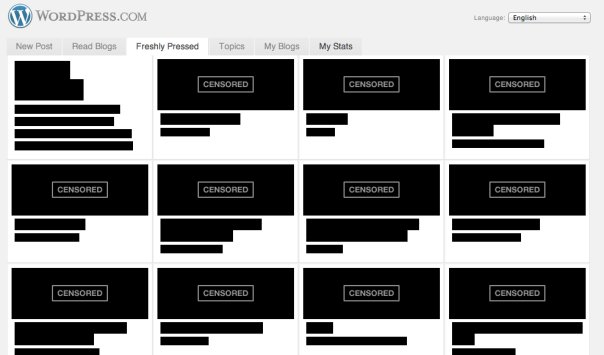
On WP.com we’ve activated an option for any of the bloggers there to put a ribbon on their site or black it out entirely, and we’ll be participating on WordPress.org as well.
6 of the 10 Republican presidential candidates are using WordPress, the other 4 are on Drupal, which means all 10 are on an Open Source CMS.
Here’s an update on WordPress woes in Kazakhstan and Kyrgyzstan. As far as I know we’ve had no contact with KazakhTelecom. Typically this happens when they don’t like something a blog is saying, so they block or degrade service for everybody. The footer of the site links to Global Voices Anonymous Blogging with WordPress and Tor guide, which is still excellent all these years later.
Jane Kim Again
I first posted about Jane Kim in 2004, on my first visit to San Francisco. Fast-forward 6 years and she’s President of the School Board and going for District 6 Supervisor in tomorrow’s elections. If you’re in San Francisco, or know someone cool who is, check out her website and keep her in mind at the polls tomorrow. Tomorrow will also be my first time voting in person instead of by mail, which I expect to be annoying but worth it Update: And she won!
Buenos Aires Day 1
Empanada dinner and Obama election party at Sacramento in Buenos Aires, Argentina.
Absentee Ballot Voting
Because of travel and uncertainty with my schedule I’m going to vote absentee in this election. There seem to be two good sites with wizards that walk you through everything: Go Vote Absentee and Long Distance Voter. Going into polls and waiting in lines seems like an anachronism. Someday I hope I can vote online.
Intense Debate Goes Automattic
Some cool news today — Automattic is acquiring Intense Debate. You can read more on Jon’s blog on Intense Debate, or on Toni’s blog, or on VC Mike’s blog.
For those of you who aren’t familiar with the product, Intense Debate supercharges the comment section of WordPress blogs and other sites with cool features like threading, reply by email, voting, reputation, and global profiles. There are a few companies tackling this space right now, but I was impressed with how much ID (Intense Debate) has been able to do with a small team, and happy to find that their common platform (PHP and MySQL) would make integration a lot easier.
Going forward, the plan is to keep Intense Debate available as a platform-agnostic independent service, much like Akismet. We’ll start to integrate its features into WordPress core, WordPress.com, and Gravatar as appropriate. For example, comment threading is going to be in WordPress 2.7, but reply by email is a lot easier to implement on a hosted service like WordPress.com. We’re also going to be able to lend our expertise in scaling to the ID team to make sure their users enjoy the same hassle-free speed and bulletproof availability as users of other Automattic services.
Long-term, I think that comments are the most crucial interaction point for blogs, and an area that deserves a lot of investment and innovation. Comments really haven’t changed in a decade, and it’s time to spice things up a little.
We were early in the space with investing in Akismet to solve the spam problem, but now I think the real growth opportunities are in the user interaction and social features across comments. There is a huge opportunity to increase the traffic and engagement of blogs significantly. WordPress.com alone already gets about three legitimate comments every second — more than a quarter of a million every day. I’m excited to see what the Intense Debate team can do to make things more interesting.
Ballot Design
How Design Can Save Democracy. AIGA tackles election ballots.
Plugin Competition
The Feed Validator is Dead to Me
Is anyone else sick and tired of the so-called feed validator changing its mind on fundamental issues every other week? I’m sure Sam Ruby and whoever else is still working on the Validator mean well, but the constant ivory tower decisions to change the way it interpets “valid RSS 2.0” is making it seem more like a political advocacy tool than anything else. Perhaps I should give the benefit of the doubt and “Never attribute to malice that which is adequately explained by stupidity.”
I’m not even talking about deciding they can change the world by decree. (Which has already been addressed.) The latest in their line of enlightened changes is that the author of the Well-formed Web spec has changed the capitializition of the wfw:commentRSS element at some unknown point to lowercase Rss. This arbitrary decision has been codified by the validator, which now reports the millions and millions of feeds that use the previously correct capitialization as invalid. Confusion ensues.
If the previous paragraph makes your eyes glaze over, congratulations, you’re normal.
Here is a post on their mailing list which also explains the issue and includes a link to the archive.org version of the page with the capitialization everyone uses, which was there for at least two years. One line can cause so much trouble.
But wait, there’s more. “In addition, this feed has an issue that may cause problems for some users.” They’ve also started marking all uses of content:encoded as potentially causing problems, which is funny because it actually avoids a ton of problems and (again) people have been using it in RSS 2.0 feeds for 3+ years now, and I even asked Dave Winer about it in the past and he said that was fine. Their documentation on the topic seems more geared toward instilling fear, uncertainty, and doubt in RSS 2.0 than addressing the reason they’ve decided to start warning about this element. Where a validator normally provides stability, the feed validator has become the Homeland Security of the RSS world, keeping us all in a constant state of dulled fear, insensitive to whatever warnings they’re giving us today because we just want it to stop.
I’m sure the content:encoded change can be rationalized with a perfectly convincing argument. I wouldn’t be surprised if someone as smart as Sam could do the same for the arbitrary wft:CommentRSS change. I know that the code is open source and we could fork it and create another version of the validator that doesn’t invalidate half the blogosphere on a Tuesday afternoon. But then we would have more than one validator, and that defeats the point.
Ken Ham Blog
I tend to link to the more liberal organizations using WordPress because that’s what I hear about, but WP is becoming popular on all sides of the spectrum, which is fine by me. Stephen Steele wrote in that famous creationist Ken Ham has a blog now. He’s also video- and podcasting.
UK Liberal Democrats
Peter Westwood wrote in that the UK Liberal Democrats election blog is on WordPress and looks pretty professional. I have no idea about UK politics, but it’s nice to see WordPress being used in more and more high-profile sites.
Voting Machines
Voting machine glitch during demo, Murphy’s law applies to elections as well. It sounds like Sequoia is trying to do the right thing. I can’t think of a single good reason not to have a hard paper copy of every vote. “Election officials say that putting printers on voting machines would create problems for poll workers if the printers break down or run out of paper, and the paper records will cause long poll lines with voters taking more time to check the record.” Oh no! People would be checking their votes! We don’t want that. I will personally donate to the paper fund if they’re really that worried they’re going to run out.
Bushlies.com
Without discussing the actual politics of the site (please) Bushlies.com is the first use of WordPress to promote a bestselling book I’ve seen. Judging by the comment counts it gets some good traffic.
Colors Found in Nature
Boxes and Arrows: Natural Selections: Colors Found in Nature and Interface Design. A fantastic article that may give you some inspiration in the contest. All the colors schemes I like that I’ve done have been directly inspired and lifted from photographs I like.
Browsing
Just a few links and excerpts I’ve come across lately.
Use absentee voting ballots so there will be a paper trail:
Michaan said, “I consider this to be the greatest threat to our democracy of anything we have ever faced in this country. There is so much possibility of fraud that there has to be a voting system that is verifiable with paper trails. Absent that we’re totally at the mercy of whoever controls this equipment.”
I have always thought it interesting that Diebold, known mostly for ATMs, has said that it would be too much trouble to have voting machines give voting receipts or some physical record of the vote when ATMs have no problem giving you a paper record of every transaction.
Quarantining dissent: How the Secret Service protects Bush from free speech:
When Bush went to the Pittsburgh area on Labor Day 2002, 65-year-old retired steel worker Bill Neel was there to greet him with a sign proclaiming, “The Bush family must surely love the poor, they made so many of us.” The local police, at the Secret Service’s behest, set up a “designated free-speech zone” on a baseball field surrounded by a chain-link fence a third of a mile from the location of Bush’s speech.
Similar suppressions have occurred during Bush visits to Florida. A recent St. Petersburg Times editorial noted, “At a Bush rally at Legends Field in 2001, three demonstrators — two of whom were grandmothers — were arrested for holding up small handwritten protest signs outside the designated zone. And last year, seven protesters were arrested when Bush came to a rally at the USF Sun Dome. They had refused to be cordoned off into a protest zone hundreds of yards from the entrance to the Dome.”
When the police attack sparked a geyser of media criticism, Mike van Winkle, the spokesman for the California Anti-Terrorism Information Center told the Oakland Tribune, “You can make an easy kind of a link that, if you have a protest group protesting a war where the cause that’s being fought against is international terrorism, you might have terrorism at that protest. You can almost argue that a protest against that is a terrorist act.”
Why does this secure CIA form for reporting terriosts use a Netscape favicon? I suppose I would be more scared if it was a Microsoft favicon. Maybe they should read my favicon tutorial.
In a thirty-five-m.p.h. crash test, for instance, the driver of a Cadillac Escalade–the G.M. counterpart to the Lincoln Navigator–has a sixteen-per-cent chance of a life-threatening head injury, a twenty-per-cent chance of a life-threatening chest injury, and a thirty-five-per-cent chance of a leg injury. The same numbers in a Ford Windstar minivan–a vehicle engineered from the ground up, as opposed to simply being bolted onto a pickup-truck frame–are, respectively, two per cent, four per cent, and one per cent.
Matthew Thomas: Why I use WordPress:
WordPress is licensed under the GNU General Public License. I generally prefer GPLed software, because over a period of decades, it maximizes the rights of those who use it. (In the short run things may be different, but I’m a long-run sort of person.)
Right on. Plus all the cool Matts are doing it.
Grants for captioning? How quaint:
The U.S. Department of Education has apparently decided that certain programming will receive sponsorship for captioning and certain other programming will not.
Joe is also running WordPress. He uses more lists than anyone I know. I wasn’t sure if Joe, a militant hand-coder, would appreciate a fully dynamic content management system, but he has taken to it swimmingly.
Iraq Agrees to Readmit Inspectors
Iraq Agrees to Re-admit Inspectors, U.N. Says–and not a moment too soon. It was starting to get hot in here.