Follow-up Questions from WCEU

Matias and I just finished up the discussion and Q&A for the online WordCamp Europe that is going on right now, which was originally happening in Porto.

There were more good questions than we had time to get to, so at the end I suggested that we continue the conversation here, in the comments section! Comments are the best part of blogging.

So if you have a question we didn’t get to, please drop it below. If you don’t have a Gravatar yet now’s a good time to make one.

Vista, SSD, and Sound

So I managed to snag a 32gb flash solid state drive. (Here’s a picture.) I personally think SSDs are the future and a computer sold with a regular hard disk in five years will seem as quaint as selling one with a tape drive is today. However the technology is still really early, as evidenced by the difficulty I had obtaining one, the cost, and the relatively small storage size (larger sizes are promised or announced, but only 32GB is commercially available). 32gb is more than enough for my primary HD, as anything heavy I can store on a cheap and slow SATA drive or on the network.
I spend a lot of time on my desktop, so I’m fairly sensitive to the speed of things there. I year or so ago I upgraded to a Western Digital 10k Raptor SATA drive and I was pleasantly surprised by the speed boost, more than I normally get from upgrading the CPU. So I thought the SSD would be a nice chance to refresh my desktop and also do a clean install of Windows Vista, which I’ve had laying around. I decided not to touch the CPU, memory, or graphics card, which are a FX-55, 4gb, and Radeon X800 respectively. Installing the SSD was easy, I just needed an IDE converter because it is laptop size.

First off, I like Vista better than Windows XP. There are just a lot of little things, like when you press Windows + M it minimizes windows on both monitors, that are a lot more polished. Also, thanks to the SSD, install and boot times are incredibly fast. Launching programs also feels snappier. The visual effects seem fine on my slightly-old video card, and in general everything feels great. There is also a benefit to wiping the OS and starting with a fresh, I probably had some cruft accumulated before which may have contributed to a slowdown. I don’t know if Vista is worth an upgrade, but if you’re going to start fresh I would go for it.

I have run into two problem, one large and one small. First, about 24 hours after I had set things up,  I came back to the computer and it said it had rebooted to recover from a “blue screen” error. I have no idea what caused this, but it hasn’t happened since.

More importantly though, something is seriously wrong with the sound. System sounds, and playing music through iTunes or Windows Media sounds great… for about 5 minutes. At some seemingly random point all the sound switches to this really awful distortion which is painful to the ear. When this happens I have to close the application that was playing sound, be it a Youtube video in Firefox or an MP3 in Windows Media, and restart the application for any sound on the computer to return to normal. This sucks. I’m just using the standard nForce sound card built into my motherboard, nothing fancy, and according to Vista it can’t find a better driver for it. I’ve googled around a lot but can’t find anyone with a similar problem, but if I figure out a fix I’ll update this entry to help future net searchers.

What is Google Cooking?

Watching my logs, I’ve been getting random requests from Googlebot for atom.xml and index.rdf files on this site and others. It’s always in the root or in relevant subdirectories (usually /blog or similar). All of these sites run WordPress, and I can promise there is no mention of or links to atom.xml or index.rdf anywhere. This means Googlebot is guessing that these files will be there. Now I’ve come to expect random flailing for syndication files from Feedster and Kinja, but Google? Et tu, Googlebot?

I suspect this is a hint of something new coming, perhaps feed-aware search like Feedster or RSS links in search results like Yahoo. Maybe a Google-aggregator? Google BlogNews? I want answers! They’ve got some room on above the search box since their redesign, maybe the next item there will be a “blog” tab. (Of course since their redesign they aren’t real tabs anymore, a regression in my opinion. I think tabs are a very effective navigation metaphor and worked well for Google.)

Anyone have any clues, ideas, or notice something similar in their logs?

Update: As always, we’re a few days ahead of the curve here at photomatt.net. Dave Winer has noticed the hits on his server and is covering the issue today.

Update: I’m late to the game, but Evan Williams confirms in part what I was suspecting and also jabs at the conspiracy theorists.

Is it more likely that this is not a calculated move, but that they are experimenting with crawling feeds in general and that, if they’re going to index them, they probably want as many as possible? And that maybe (hmmm…) they started with Blogger blogs first, since they were handy, and they tended to find feeds at index.rdf and atom.xml, and they haven’t yet optimized their crawler because they’ve been working on other stuff?

MX900 on OS X

I could not be happier, I finally got my MX900 bluetooth mouse working correctly on Mac OS X. To clarify, it always worked but I had 5 buttons that were just there for decoration, and I really missed the back and forward buttons. The magic application that made my day? Gamepad Companion. I tried a couple of others, including the awful Logitech software, and nothing even came close to working. For future reference here are the button assignments on the mouse as shown in the interface:

  1. Left button
  2. Right button
  3. Wheel button (press down on wheel)
  4. Side back arrow button
  5. Side front arrow button
  6. Switch window button (below wheel)
  7. Up scroll (above wheel)
  8. Down scroll (below wheel)

The only thing that would make it perfect is if I could make the wheel button a double-click.

Comscore, whose accuracy is generally between a Lotto Quick Pick and a drunken dart throw, says Google Maps usage has fallen since Apple Maps came on the scene. The Guardian has a good overview: How Google lost when everyone thought it had won.

We shouldn’t be surprised that in the absence of choice, people take the path of least resistance. What’s missing in these discussions is how it’s criminal Apple gets away with not allowing alternative defaults for maps, browsers, calendars, and any number of other areas, which means every time you click a link or address in the OS it opens Safari or Apple Maps, in my opinion inferior apps. Some developers get away with this by having settings to set Chrome or Google Maps as your default, like Tripit just added, but this is implemented in a hacky, per-application way, and every app puts their setting in a different place if they support it at all.

If Microsoft did this a decade ago we’d call for the DoJ to reopen their investigation. Apple has the best phone, best tablet, and in many ways the best operating system — we should not give them a pass for this blatantly self-interested and user-hostile stance. Defaults matter.

New Servers

We’re looking to expand into a third datacenter for WordPress.com and related Automattic stuff. I’ve been asking around for quotes, but it occurred to me I should blog what we’re looking for because someone reading might be able to provide what we need, or know someone who could. One line summary of what we’re looking for: 22 boxes, AMD 3800 or similar, cheapest HD, 1-2gb of RAM, Debian AMD64 (this is important), private and public 100mbps network. I’d be happy to post more info in the comments if anyone wants it. A per-server monthly price including space and bandwidth is what we’re looking for.

Staticize Reloaded

The caching plugin I pointed to the other day was very well-executed but it didn’t meet my needs for several reasons, mainly that it cached every bit of output, which wouldn’t be appropiate for things like my random photo. (Or my non-rotating photo formerly known as the random photo in the header. It’s on break right now.) My site is a pretty neat system of PHP includes, and I want to preserve that because it makes my life easy and doesn’t slow anything down any perceptable amount.

So I took the Staticize plugin and added support for dynamic non-cached sections, cleaned up the code a bit, fixed a weird problem where it would just show a blank page if it couldn’t write the file, fixed the problem with edit links and the comment form, and made it fit with the WordPress code a little smoother. Full instructions are included with the plugin, but to install just make sure your wp-content folder is writable (you may have already done that when setting up WP) and activate the plugin, and it will start working immediately.

I have a couple more improvements in mind for it already, but it’s fully functional and I’m running it right now.

Download Staticize Reloaded 2.0.

Facebook Over-optimization

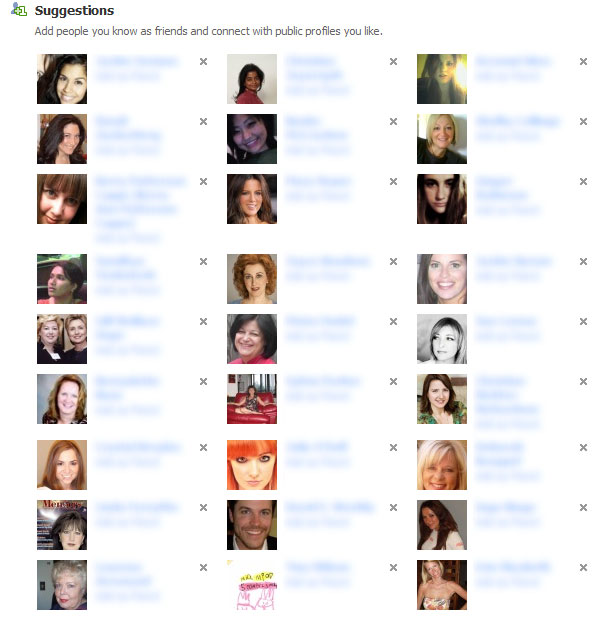
On Facebook I was trying to get to an event and clicked “see all” on the friend finder instead of the events area. Then something caught my eye, every friend Facebook was suggesting for me was female, and most I didn’t know. (Update, there’s one guy in there.) The first part of that is interesting — perhaps they’re testing some optimization in the friend-adder with the assumption that since I’m a straight male I’m more likely to add girls than guys, but if so that seems a little skeezy.

Bangkok Unrest

In celebration of my arrival in Bangkok the opposition party is apparently planning a million person “red shirt” rally. Exciting! On the bright side, “The UDD [United Front for Democracy against Dictatorship] can only afford to keep its protest going for three to five days. If the government has not fallen by that time, it will have to withdraw and draw up a new strategy.” I always pick the best times to travel. 🙂 (Mom, don’t worry. I’ll stay safe!)

Songs for My Father

One of the things that surprised me most about when my Dad was sick last year was that while he was in the hospital over about 5 weeks he lost any interest in music, TV, movies, anything on a screen. Music was particularly surprising given that he had music on at his desk pretty much all the time, and really enjoyed loading a new CD or record into the media library he had set up at home. One of the songs I remember playing for him was from a band, Manhattan Transfer, that we used to listen to a lot when I was younger and just learning about jazz, I chose Tuxedo Junction because it might cheer him up.

I remember him smiling faintly. (I wish I had played him more music. I wish I had recorded more of his stories, ideally before he got sick. I wish I had figured out how to navigate the hospital and health care system better.)

What I didn’t anticipate was how after his death there would be aftershocks of grief that would hit me over and over again, especially while driving or in a plane. I went from crying maybe three times in the past decade to breaking down at the end of a company town hall, when talking to family, when my Mom found out about the anniversary present my Dad had been looking at, and with any number of songs that unexpectedly took on a new meaning.

Wiz Khalifa & Charlie Puth’s See You Again, is obvious, and was in heavy rotation every public place I went; Lukas Graham’s 7 Years completely broke me down when it talked about children — if I ever have any my father will never meet them; Kayne & Paul McCartney’s Only One, the tribute to Kanye’s daughter and passed mother and I think perhaps his best song; Ed Sheeran’s Thinking Out Loud, about growing old together, turning 70 as he was so close to doing; Kanye’s Ultralight Beam snuck up on me, I didn’t expect it, but the questioning and gospel and anger and hope in it captured something I didn’t even realize I was feeling. Even jazz wasn’t safe, Horace Silver’s lyric-less Song for My Father had the same effect.

ultralight.gif

John Mayer’s Stop This Train is a song I’ve probably heard a hundred times since it came out in 2006, but all of sudden these words meant something completely different:

So scared of getting older
I’m only good at being young
So I play the numbers game
To find a way to say that life has just begun

Had a talk with my old man
Said, “Help me understand”
He said, “Turn sixty-eight
You’ll renegotiate”

I almost had to pull the car over: he was sixty-eight. What I would give for just one more conversation with him like the one the day before he passed. I wish I had written more down, recorded more of his stories, learned more about his journey.

As the year has passed, the surprise crying is much less common even when one of these songs comes on the radio. Usually when I think of my father it’s with a smile. I’ve even had a few treasured dreams where we’ve been able to talk, nothing that made much sense (it was a dream) but I remember waking up with an overwhelming feeling of enveloping love. While the “new normal” is different, I can’t say it’s better — he’s still gone.

Switching to Google Reader

I held out on using a RSS reader for more than two years. I had a little thingy built so Ping-O-Matic would use its own results and Weblogs.com to store the last updated time of every blog it saw, and then I reordered my blogroll based on that. (The original version in WordPress parsed the whole changes.xml from Weblogs.com a few times an hour. Remember when that was feasible?) Then I would go from the top of the list to the last one I remember reading, opening each in tabs, and closing as I finished. Incidentally, this kept my blogroll from withering as many do.

At some point I started begrudgingly using Bloglines in 2004, and fell in love shortly thereafter. Where I used to follow a few dozen blogs, now I could consume hundreds and its UI just made sense to me, and just got better over time. I sang its praises often in interviews, mentioning it as one of the handful of websites I used daily. Any outages or performance problems it had seemed minor to me, only reminding me of how much I appreciated the service when it was up. Bloglines search was and continues to be the cleanest in the space.

I don’t recall exactly when many of my friends started switching to Google Reader. I had tried it at its first release and was pretty unimpressed. I saw the hubabub around Gears and how Reader was the first to embrace that. I watched with envy as friends used their trends feature to see nifty data about how and when they read feeds, and use it to cull out the non-essentials, much like I used to with my blogroll.

A week ago, frustrated to no end by a bug in Bloglines telling me to reread things I already had, I decided to make the switch cold turkey. I packed my OPML file and went along to Google Reader full-time. It hasn’t been painless — the keyboard shortcuts are a little funky on dvorak — but it feels better to be on a platform that whether real or perceived feels like it has momentum. That self-fufilling X-factor in apps is one of the magic elements for me. Also as I’m adapting to the UI I feel a lot more efficient than I used to in going through things.

Finally I’ve started reducing my subscriptions, down to 346 now, and I hope to be under 200 within a month or so. I’m thinking of adopted a fixed-number, say 150, and if I want to add one I need to remove another one first so the total is always the same. (I’ve considered this for social networking sites, too.) However it’s probably focusing on the wrong metrics, unread items is more important than total feeds.

OpenDNS

OpenDNS is a great idea, well-executed. They took something basic and ubiquitous, DNS, and improved it by adding spell-checking and phishing protection (usability enhancements). They provide the service for free in exchange for monetizing typo search pages. The typo search pages are simple, fast, and generally useful. What I was looking for is usually the first result. There is no software to install, just two settings to change, and they provide a registration-free way to set preferences on their site. John Roberts is a friend from my CNET days and gave me a preview a few days before they launched, I've been using it full-time ever since and it has been invisible in all the right ways.

Five for the Future

On Sunday at WordCamp Europe I got a question about how companies contribute back to WordPress, how they’re doing, and what companies should do more of.

First on the state of things: there are more companies genuinely and altruistically contributing to growing WordPress than ever before. In our ecosystem web hosts definitely make the most revenue and profits, and it’s been great to see them stepping up their game, but also the consultancies and agencies around WordPress have been pretty amazing about their people contributions, as demonstrated most recently by the fact the 4.0 and 4.1 release leads both hail from WP agencies (10up and Code for the People, respectively).

I think a good rule of thumb that will scale with the community as it continues to grow is that organizations that want to grow the WordPress pie (and not just their piece of it) should dedicate 5% of their people to working on something to do with core — be it development, documentation, security, support forums, theme reviews, training, testing, translation or whatever it might be that helps move WordPress mission forward.

Five percent doesn’t sound like much, but it adds up quickly. As of today Automattic is 277 people, which means we should have about 14 people contributing full-time. That’s a lot of people to not have on things that are more direct or obvious drivers of the business, and we’re not quite there today, but I’m working on it and hope Automattic can set a good example for this in the community. I think it’s just as hard for a 20-person organization to peel 1 person off.

It’s a big commitment, but I can’t think of a better long-term investment in the health of WordPress overall. I think it will look incredibly modest in hindsight. This ratio is probably the bare minimum for a sustainable ecosystem, avoiding the tragedy of the commons. I think the 5% rule is one that all open source projects and companies should follow, at least if they want to be vibrant a decade from now.

Further reading: There’s been a number of nice blog follow-ups. Post Status has a nice post on Contribution Culture. Ben Metcalf responded but I disagree with pretty much everything even though I’m glad he wrote it. Tony Perez wrote The Vision of Five and What it Means. Dries Buytaert, the founder of Drupal, pointed out his essay Scaling Open Source Communities which I think is really good.