Category Archives: Tech

Technology, gadgets, software, and the industry around them.

Almost 3 years ago we released a version of WordPress (3.0) that allowed you to pick a custom username on installation, which largely ended people using “admin” as their default username. Right now there’s a botnet going around all of the WordPresses it can find trying to login with the “admin” username and a bunch of common passwords, and it has turned into a news story (especially from companies that sell “solutions” to the problem).

Here’s what I would recommend: If you still use “admin” as a username on your blog, change it, use a strong password, if you’re on WP.com turn on two-factor authentication, and of course make sure you’re up-to-date on the latest version of WordPress. Do this and you’ll be ahead of 99% of sites out there and probably never have a problem. Most other advice isn’t great — supposedly this botnet has over 90,000 IP addresses, so an IP limiting or login throttling plugin isn’t going to be great (they could try from a different IP a second for 24 hours).

Evolution of San Francisco

There have been three excellent writings on the effects and consequences of the latest boom on the Bay Area, each long but worth reading.

The East Bay Express, with a permalink I’m sure won’t work a decade from now, brings us The Bacon-Wrapped Economy:

The arts economy, already unstable, has been forced to contend with the twin challenges of changing tastes and new funding models. Entire industries that didn’t exist ten years ago are either thriving on venture capital, or thriving on companies that are thriving on it. It is now possible to find a $6 bottle of Miller High Life, a $48 plate of fried chicken, or a $20 BLT in parts of the city that used to be known for their dive bars and taco stands. If, after all, money has always been a means of effecting the world we want to bring about, when a region is flooded with uncommonly rich and uncommonly young people, that world begins to look very different. And we’re all living in it, whether we like it or not.

SFGate has The hypocrisy in Silicon Valley’s big talk on innovation:

“[I]nnovation” is something of a magic word around here, shape-shifting to fit the speaker’s immediate needs. So long as semiconductors and coding are involved, people will staple it to anything from flying cars to the iFart app.

Other times it’s just code for “jobs,” used to justify asking for government favors one day and scolding them for meddling in the free market the next.

“Lower our payroll taxes because … innovation.”
“Drop that antitrust inquiry because … innovation.”

But for all the funding announcements, product launches, media attention and wealth creation, most of Silicon Valley doesn’t concern itself with aiming “almost ridiculously high.” It concerns itself primarily with getting people to click on ads or buy slightly better gadgets than the ones they got last year.

The final comes from Rebecca Solnit, who I’ve quoted before, writes a diary for the London Review of Books.

I weathered the dot-com boom of the late 1990s as an observer, but I sold my apartment to a Google engineer last year and ventured out into both the rental market (for the short term) and home buying market (for the long term) with confidence that my long standing in this city and respectable finances would open a path.

TechCrunch writes WordPress.com Has Imported 15M Posts In The Last 30 Days, Remains A Top Safe Haven For Nomad Bloggers. I’m very proud of the 8+ years we’ve been a home for, and protected, our users blogs. Protection covers many aspects: backups, scalability, security, speed, permalinks, mobile versions, forward-compatible markup, clean exports… the list goes on. We’ve done the same with other internet-scale services, like Akismet, Gravatar, and Jetpack, and I hope to earn the same trust in the coming decade with VaultPress and Simperium.

Ray Bradbury passed away last week, leaving a legacy large and full of gems like this 2001 advice to writers. Care of Elise Hu, here is a snippet of a 2002 interview Bradbury did on NPR, portions of it unaired, relevant to our culture of distraction thread:

But if we finally correct this in our school system, what kind of student should we deliver to the world? A student who has wide ranging tastes — all kinds of literature, and basically, we should head in the direction of having young people read science fiction.

Why? Because we live in a science fiction time. The last century we invented flying, we perfected the railroad system, we made telephones available to everyone in our culture, and then we invented radio in 1922, and it began to dominate our culture. Then television came along in 1945. So we’re surrounded by all these devices.

We are a device oriented culture. So how can you not want to read about what these things are doing to you and to others and to the world?

And we invented atomic power in the middle 40s, and that became a Christian invention. Why do I say that? Because it prevented wars after the first big dropping of the bomb on Hiroshima. After that we were able to back Russia down and make the wall in Berlin fall, all because of atomic power. All this being true, you can’t neglect it, you must write about it. And the mainstream writers of our time didn’t write about it. So they became very boring.

Young people graduating from high school should be curious about the impact of the fax machine, of the telephone, of atomic power. So you write stories for them. And during the last 20 years, science fiction has come into its proper place and is being taught in middle schools and high schools and colleges, because people are curious about a world where we promised to go to the moon, and we finally do.

iPad 3 Launch Experience

I’m in New Orleans for a few days and, long story short, although I pre-ordered the New iPad it’s arriving to an address I won’t be at for a while, so since I was up early this morning thought I’d go to the nearest Apple store in Metairie and see if I could pick one up, or at least be part of the excitement that always accompanies Apple launch mornings.

The store had opened at 8, but I arrived at about 8:55, and the scene was not at all what I expected. There was a crowd outside the Apple store, but it was of blue-shirt employees, I walked up and said I was there for a 64GB white AT&T iPad, the fellow handed me a card, and 5 minutes later I was checked out. No line, no waits, no anything! Here’s a picture of the front of the store, at 9:20am.

Line at Apple Store

The woman who checked me out said there had been a bit of a line that morning at 8, but just about 20-30 people and she thought that most people didn’t know they were opening at 8 that morning instead of the normal 10.

I walked back outside and grabbed a water bottle from the big pallet they had of them (for the expected line) and a Verizon employee accosted me to show ask if I had gotten AT&T or Verizon. When I replied “AT&T” he said “oh man!” and showed me the speed tests he was getting on his iPad 2 tethered via wifi to a Droid device he had, an impressive 20mbps down. “Think how fast it’d be going direct to an iPad.” (I agree, but I already have a Verizon Nexus device, a T-Mobile Blackberry, a Sprint iPhone, so I wanted to complete the quartet with another carrier and ensure I could have coverage anywhere.) I decided to celebrate with some beignets across the food court from Cafe Du Monde:

Celebratory Breakfast

So why the lack of a line? Perhaps it was mix up about store opening time, as they suggested. Maybe New Orleans is a Samsung town. Perhaps Apple just did a better job with the pre-orders arriving on launch day, so people didn’t feel the need to go to the store. Maybe people weren’t as excited as I was about the new launch. All in all, it doesn’t matter to me. The screen is gorgeous, it’s restoring now from iCloud backup, and I’m pleased as punch to have one on launch day and I’ll probably spend far too much time today staring at the amazingly high resolution. If you were waiting because you thought the stores might be crazy today, maybe head to them half an hour after open time and skip the queues.

“Apple Lossless, also known as ALAC, is a lossless audio codec Apple developed some time ago for digital music. The codec compresses music files anywhere from 40-60 percent of their original size with no discernible loss in audio quality or fidelity.” — Apples ALAC codec is now open source. About a year and a half ago I started re-ripping all my music in ALAC, it’s fantastic, especially now that iTunes can down-convert when syncing to iPhones / iPods.

What’s Next for Apple

I have no inside information or insight, but historically Apple’s product improvements have strongly broadcasted where they’re going in the future. Here are six things I think are inevitable for Apple to do over the next decade, from most to least obvious: maps, iCloud, payments, TVs, search, and cars.

1. Maps

When the iPhone was first released Steve Jobs called Maps on iPhone the best version of Google Maps on the planet, with emphasis on what Apple’s designers had brought to Google’s raw technology (can’t find that link). Four years later, you can’t imagine such a core piece of the mobile experience reliant on their largest competitor. Hopefully this will also give Apple a chance to fill usability gaps in the maps experience today, like that you can’t click from the “where” field in a calendar appointment straight to maps. (Drives me crazy.) Note that the only “Google” branding in maps today is in the bottom left, they know they’re getting replaced and have done an admirable job on the Safari version of maps on iPhone and iPad.

Google Maps + Navigation on Android is my favorite mobile app of the past 3 years (haven’t used Siri yet) — it’s what Garmin should have built $8 billion in revenue and R&D ago. (Remember the Garmin Nüvifone?) Apple was smart to partner in the beginning, but they can, and should, raise the bar.

2. iCloud

The abstraction of documents, photos, videos, their equivalents in “bought” media (iBooks, music, movies, and TV shows from the iTunes store), the deemphasis of the filesystem with every iteration of OS X, and the rough ideas of things like MobileMe’s dock syncing, points to the combination of services that will ultimately disrupt the “magic folder” providers like Dropbox. I love Dropbox, but it’ll be impossible for them to do the deep OS integration needed to match the direction Apple is heading — never thinking about what is where, ever again, just having everything you’ve ever created or used available in the same place on all your devices.

They know this is best for consumers. My friend Rene told me how when his hard drive crashed last year he contacted Apple support and they gave him a link to re-download the past 4 years of music he’d purchased on iTunes. That’s obviously the right thing to do, even if labels have had to be dragged kicking and screaming toward it. By this time tomorrow it’ll just be part of the experience when he signs into iTunes on a new computer. Update: Apple released iTunes 10.5 a day early with this feature.

3. Payments

Your phone becomes your credit card. Apple doesn’t replace Visa or Mastercard, but they do replace all of those scammy rewards and branded cards that prey on unsophisticated consumers. Google will probably do this first, but it’ll be like Microsoft Surface, brilliant but two sandwiches short of a picnic.

4. TVs

I recently got one of the new Thunderbolt displays and man, a super-sized version of this would be killer in my living room. (The speakers are surprisingly good.) TVs are just so bad, not so much in the hardware which can be beautiful like Samsung’s C9000 but in the mediocre software, un-features like Auto Motion (which makes beautiful films look like they were shot by a Jersey Shore cameraman with a beer in his other hand), and interfaces that just don’t do anything you would expect. Hello — you can detect when a cable is plugged in, don’t make me switch between 15 sources when only one is connected. My TV takes 5-10 seconds longer to turn on than my iPad. “Smart TVs” look like “smart phones” did in 2005 — completely lacking in imagination or joy.

But to really imagine the strategic importance of this you need to think beyond a super-sized Thunderbolt display and imagine what replaces iMac, one of Apple’s most beautiful creations. People’s need for a desktop is seriously declining for the first time since pundits started predicted the decline of the PC a decade ago. The post-PC ecosystem is in place now — touch, battery life, mobile-first applications, ubiquity of internet access, flash memory. (In Steve Jobs introduction of the first iPod, two things stand out to me: that terrible font, and the fact one of the main features is 20 minutes of skip protection.) Mobile works and is getting better, and you won’t have what we call a desktop 10 years from now.

Now imagine Apple has a shining 55″ monolith smack dab in the middle of your house. How big of a wifi antenna could they put in there? Could they crush all that lame Cisco teleconference stuff with TV FaceTime? Is there room for a few disk drives that don’t need to worry about skipping plus a SSD to make it fast? If you look at the direction Apple has been heading with Time Capsule locally caching software updates it’s not hard for something similar to work in the other direction, a digital hub that’s your media server for the house, a large-format display, a time capsule, and an Airplay target all in one. Imagine just one power cable coming out of it, and everything else wireless, just like the iMac, and a few killer apps we can’t even imagine yet.

Finally, home theatre needs disruption — this is a land of $200 Monster HDMI cables and similar gouging that functions like a state lottery, an intelligence tax. When I walk through Best Buy, which I try to do once every few months, it feels like it’s technology at its worst, the magic of progress used as smoke and mirrors to confuse and dupe consumers rather than make their lives better. The Apple TV is just another form factor for the unified experience Apple wants to create every time you touch an electronic device.

5. Search

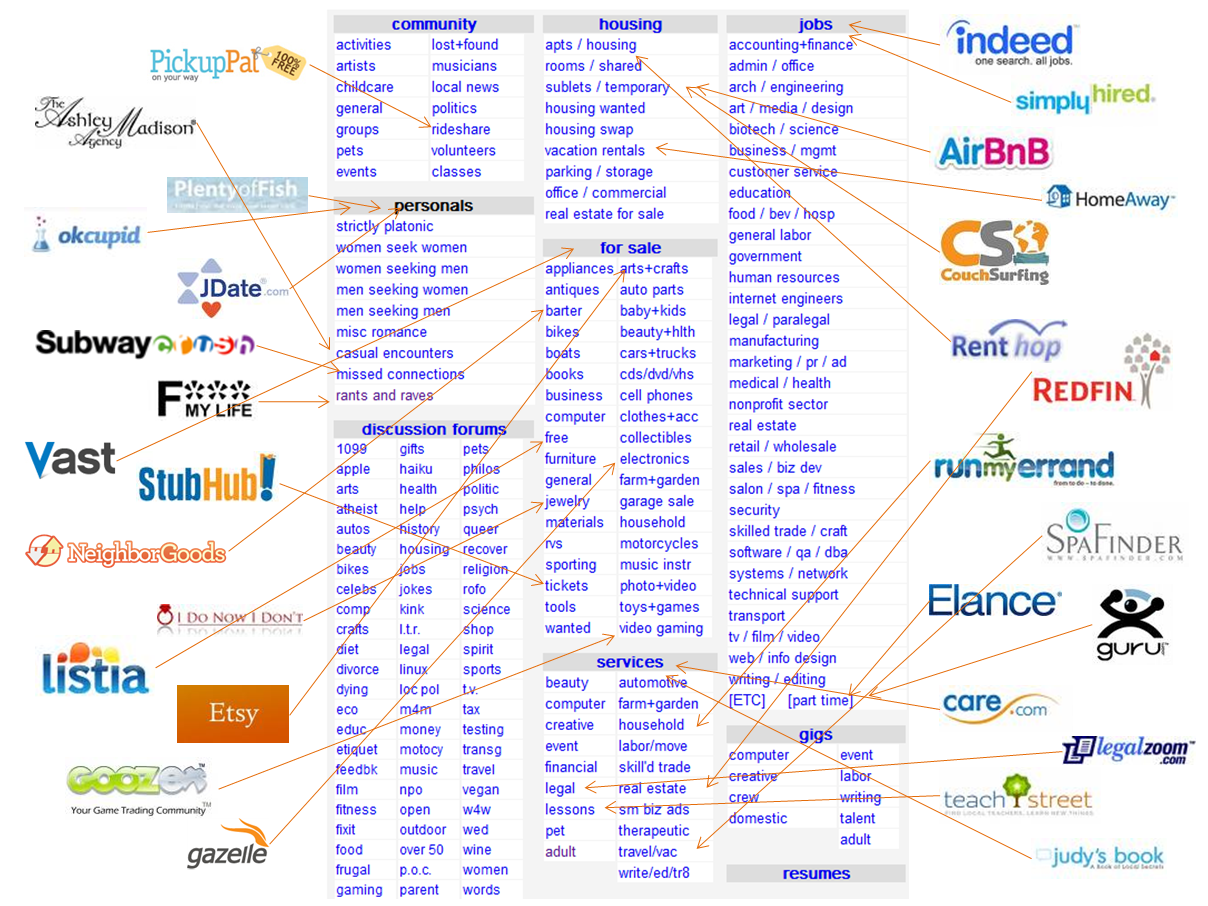
There are hints of this in maps, but just like Craigslist is being killed not by a Craigslist-like clone but rather by a thousand highly focused replacements, so too Google will face its existential crisis not from another webpage with a centered white box, but from the interface and context of search changing completely. Many of Google’s searches aren’t that valuable, and a huge percentage of the ones that are aren’t going to happen at the desktop anymore .The context of your location (which your phone already knows) the “results page” of a fantastic map application and the input of a next-generation search interface, like Siri, completely changes the rules of engagement. Google’s not investing in mobile because they wanted a better phone.

6. Cars

This is the most far-out, but I think most certain. Voice-controlled search through Siri and Apple Maps provide the hands-free framework for a rich interactive experience while driving. Walk down the car stereo aisle in Best Buy and see what $800 gets you, or a $300 GPS from Garmin, vs an iPad or iPhone. The screens feel like a TI-92 calculator. The typography makes my eyes bleed. I find it morally reprehensible how bad these products are because it’s one of the areas of technology where a bad interface is most directly tied to injuries and deaths. Car folks are making their iPhone/iPod integrations better and better, which may be a glass of ice water in hell, but they’ll never make the jump to providing a beautiful marriage of media, search, and navigation that a great in-car experience needs. Right now you can spend 110k on a Tesla Roadster, a car of the future, and for an additional $4,500 (9 iPads!) get this Alpine head unit. (Watch that video and try not to laugh at how bad the interface is.) Retail it only sets you back 1.4 iPads. That’s just sad.

“People who are really serious about software should make their own hardware.” — Alan Kay, 1982. People who make hardware should get their software act together before Apple does for them.

Discussion on Hacker News.

The official URL for Amazon’s new browser, Silk, is amazon.com/silk which right now redirects to amazonsilk.wordpress.com. This is not a VIP deal or anything, it’s just a free blog on WP.com which Beau noticed from their press release. I’m guessing they just wanted a quick and easy way to make a functional and beautiful website, which is kind of the whole idea of WordPress. 🙂

The TimThumb Saga

Last week there was a serious flaw found in the code behind TimThumb, an image re-sizing library commonly used in premium themes.* Because the code is commonly embedded in themes it’s not easy to discretely update like it would be if the code were a plugin, and even when a theme is updated people are hesitant to update because they often customize theme code rather than making child themes, so if they were to overwrite their theme with a new version they’d lose their modifications. That, combined with the severity of the flaw, means that this is one of the more serious issues in the WordPress ecosystem in a while, even more than normal because it wasn’t in core.

It could have gone a lot of ways, but the incident brought out the best in the community. The core team sprang into action searching through the theme directory to inoculate any themes that contained the dangerous code. Community blogs quickly got the word out about the problem so people were aware of it. Mark Maunder, who originally discovered and broke down the problem, created a fork of the code called WordThumb that rewrote TimThumb from the ground up. Forking is not usually ideal because it fragments the market for users but Mark soon connected with Ben Gillbanks, long-time WordPress community member, and they’ve teamed forces to release TimThumb 2.0, a collaboration that exemplifies Open Source at its finest. An updated plugin should be in the directory shortly.

It also illustrated the original vision I had behind VaultPress. In addition to reporting early and emailing customers with vulnerable code, the following morning they had devised a way to go in and surgically correct vulnerable code on over seven hundred affected websites. This fixing-problems-while-you-sleep delighted users and is exactly the kind of problem I hoped VaultPress would solve for people and it underscores the core value of the service. If you’re not using VaultPress for your most important websites yet, you should.

* I originally had a long rant here, but here’s the 13-word version: I’ve seen no correlation between how much something costs and its code quality. This is getting better as more people become familiar with the coding standards of core, and PHP in general, but there is still a long way to go. If you want to avoid this in your own code, check out Theme Check and Log Deprecated Notices to start. If you’re looking for code to base your own theme on, it’s best to start with something like 2010 or 2011.